Showing posts with label ballistic missiles. Show all posts

Wednesday, July 27, 2011

Mark Kirk gets his feelings hurt, says a spectacularly dumb thing

Russian ambassador to NATO/kooky unreformed nationalist Dmitri Rogozin, who has a habit of saying (and tweeting) somewhat nutty stuff, took a whole bunch of shots at unilateralist Russophobe dinosaurs/U.S. Senators John Kyl and Mark Kirk in his country's press after meeting with the two this week. The story is related by Josh Rogin at The Cable. Here's the money line from Rogozin:
"The meeting [with Kirk and Kyl] is very useful because it shows that the alternative to Barack Obama is a collapse of all the programs of cooperation with Russia. Today, I had the impression that I was transported in a time machine back several decades, and in front of me sat two monsters of the Cold War, who looked at me not through pupils, but targeting sights."
The guy is always good for a few lulz, but Kirk was less amused. He gave Rogin a few snippy quotes that aren't worth recounting, but also dropped what I imagine he thinks is the hammer:
"In a potential missile combat scenario between NATO and Iran, Russia is thoroughly irrelevant. So Russian concerns about what we do and not do about the Iranian threat are interesting but largely irrelevant."
Wow. Russia is thoroughly irrelevant, and its concerns are largely irrelevant. (See if you can't sort that one out for yourself.)

I know it's probably a bit much to expect sophisticated understanding of strategic deterrence theory from a guy who "misremembers" his own military record, but could we at least hope for some common sense?

"In a potential missile combat scenario between NATO and Iran," precisely nobody with nuclear weapons and an early-warning/launch detection system is "irrelevant." Especially not a state with a massive arsenal of nuclear warheads and the delivery systems to get them to American soil, one with a cultivated distrust of American intentions vis-a-vis missile defense.

"In a potential missile combat scenario" in which the sky fills up with ballistic missiles, every damned guy on the planet with a red button is going to go reaching for it until he has a pretty solid sense that none of those missiles is going to land on him. That solid sense is probably going to take just a little while longer to materialize when you've got a bunch of senior "statesmen" running their yaps and posturing in ways that seem almost certainly intended to impede information-sharing and common understanding, to keep the other guy off balance, wondering if -- in spite of official policy statements to the contrary -- our missile defenses really are targeting his weapons.

Russia's "irrelevant" to a scenario that could kindle nuclear war, huh, Senator? More irrelevant than a guy who has to shit-talk his own government to America's biggest foreign creditors just to get on the news? More irrelevant than a guy who spent much of his time in the House impotently railing against the government's irresponsible spending habits while serving as a member of the body that writes America's checks? More irrelevant than a guy whose idea of inspired leadership and aggressive oversight is pathetic obstructionism and delaying tactics in a condominium of ignorance with the U.S. Senate's most trifling and manifestly inconsequential clowns?

Well hell, Rogozin, I might take "irrelevant" as a compliment coming from that guy.

Monday, June 13, 2011

Gulliver? More like Dulliver! Exciting expert guest-post analysis of, uh, submarine stuff

Gulliver here: As some readers may know from past allusions, my brother is an active-duty line officer in the U.S. Navy. He's just as wonky and opinionated as I am, but less obnoxious; most importantly, he's almost certainly possessed of more useful technical knowledge than I. It frequently happens that I read something about shipbuilding or maritime security or China's naval buildup and write him to say "man, I can tell this is wrong, but I don't know enough to really say why, so fill in the substantive rationale for my pre-formed analysis, please." He finally took me up on one of my repeated invitations to write something for us, and I hope he'll continue to do so from time to time in the future. I've edited him slightly (which will surely infuriate him) and added a few bracketed comments to de-wonk just a little bit, provide context, and make it more suited to a general audience.

Has China built a new stealth special operations submarine?

A few weeks ago, Galrahn at Information Dissemination published some recent pictures of a new PLAN submarine. It’s clearly the same boat launched at Wuhan Shipyard in September, somewhat hilariously postulated here to be a “Chinese stealth submarine.” I’d like to address a few of Galrahn’s hypotheses.

The thing I have the least trouble agreeing with his initial reaction: that it’s reminiscent of a GOLF SSB. The long sail is the strongest clue for me that it is, in fact, a GOLF SSB replacement – most likely intended as a one-off submarine-launched ballistic missile (SLBM) test platform. There’s simply no reason for a sail to be that big unless you’ve put something inside it. [To clarify, what he means here is that it's plausible that the sail is so big because it covers ballistic-missile tubes.] The sole purpose of the sail is as a fairwater to cover the access trunk to the bridge hatch, the masts and antennas, and any other installed equipment. The American LOS ANGELES SSN sail contains an access trunk, 5 masts and two periscopes. It’s just big enough to cover these things. 

Galrahn speculates that the larger sail could be a storage area for “special operations equipment,” but there’s no reason this equipment couldn’t be stored inside the pressure hull. Either the equipment there would be exposed to the sea or the whole sail would have to be hardened to withstand submergence pressure. I’m not sure what the point would be, especially if the vessel's hull was purpose-built for specops and not simply an older design modified to that end. The sail would have to be opened while at sea, probably while submerged, to access whatever equipment was stored there. This introduces new complications. If the purpose is to stow equipment protected from the elements, then the opening would need to be above the water line when you open it – so you can’t do it submerged and covert. If it’s open to the sea, what are you putting in there?  Rubber boats? A little teeny self-propelled spec ops delivery vehicle?  This is how U.S. boats carry their spec ops equipment. The large sail hatch to which he refers is just what it looks like: an access hatch. It’s in the free-flood area of the sail and is used for personnel and equipment to access the masts and antennas that are housed inside. ["Free-flood" means that water fills this portion of the sail when the submarine goes to depth -- it is not protected from seawater.] The whole “special operations SSK” idea just doesn’t make sense.

As for the suggestion that it could be intended as a mobile DF-21 [anti-ship ballistic-missile] platform, I initially reacted with skepticism. Surely the missile’s too big, right? Nope – the DF-21 turns out simply to be a land-based version of the submarine-launched JL-1 SLBM, so it's small enough to be taken to sea. But what would be the point? Well, extending the range of the “access denied” area for U.S. forces seems like a pretty good goal, if a little gratuitous. The point of anti-access weapons is to keep opponents away from your stuff – most importantly, to keep an aircraft carrier out of its aircraft’s effective combat radius from Taiwan.  Keeping American carriers out of the western Philippine Sea is one thing; parking a sea-mobile DF-21 east of Taiwan and pushing the carriers further east seems to be a wasteful expenditure of resources. Another important aspect of anti-access weapons generally and the DF-21 specifically is that the Chinese are going to want us to know that it’s there. They’d much rather we just stay out because of the prospect of a carrier getting shot than that they actually have to shoot at a carrier and then we stay out, wouldn’t you think? SLBMs as an assured second-strike ICBM capability: great idea. SLBMs as a hidden anti-access weapon make less sense to me.

It’s not really plausible that this could be initially intended for JL-2 tests and then to carry a seaborne DF-21: the sizes of the missiles are too different. The JL-2 is 2m in diameter and 13m long, while the JL-1 is just 1.4m/10.7m. Based on the size – it’s significantly larger than the YUAN SSK also visible in this picture – it seems likely to me that it’s designed for the bigger missile and will be a SLBM test ship.

Unrelated note: There’s been some recent fuss about the Chinese aircraft carrier and whether it’s a big deal or not. I hope to address this debate in an upcoming post. Teaser: it’s not a big deal, but it’s not the Chinese naval capability that matters to us.

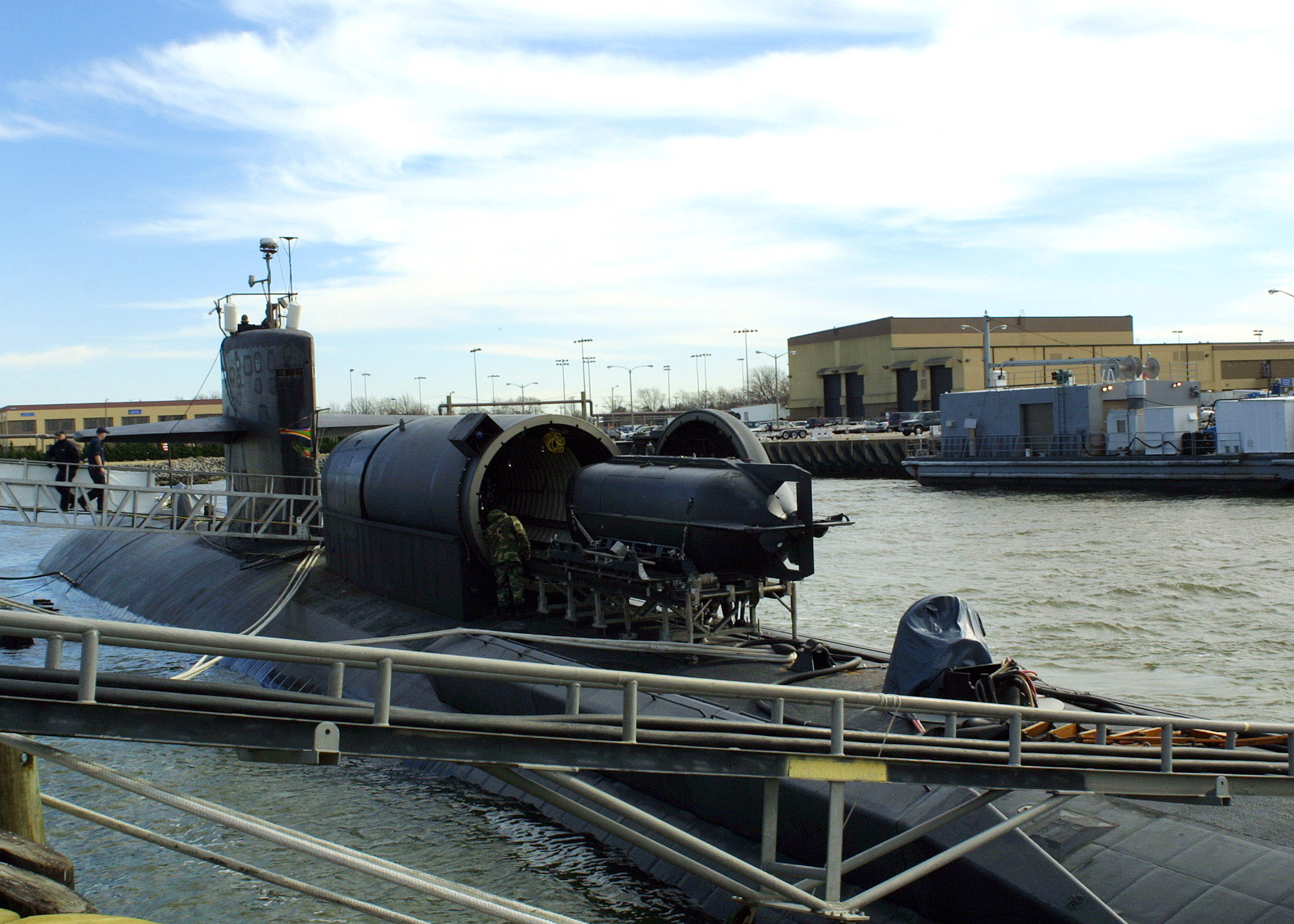
Gulliver again: Personally, I think it's my responsibility to assure you that all of the speculation above is nonsense. The hatch in question is really a bay door for the sophisticated caterpillar propulsion device, a fact that was revealed through consultations with a subject matter expert during hours of imagery analysis, shown here.