On June 15th, in a sign of strengthening ties between rising Eurasian powers, the six defense ministers of the Shanghai Cooperation Organization issued a joint communique slamming U.S. plans to revise the Anti-Ballistic Missile (ABM) treaty.
Oh, no, wait, just a second... that communique was issued on June 15th, 2001. Yeah, ten years ago. And here I was prepared to acknowledge that this powerful signal of cooperation between Beijing and Moscow constituted a "mile marker on the road" to "a China-Russia entente [that could soon dominate] the international distribution of resources and [will be] ascendant economically"!
That would be pretty stupid, though, seeing as a decade has passed without giving any real indications that this sort of anti-American balancing coalition had even the most remote chance of materializing (or that if such a coalition did form, it wouldn't be similarly balanced against by the presumably predictable anti-hegemonic behaviors of other states).
Seriously, though, this particular SCO declaration, the one that happened this week, where Russia, China, and their Central Asian little brothers declared opposition to U.S. plans for theater ballistic missile defense... this one is definitely foreboding. Way more foreboding than that other outraged communique from a decade ago. Especially since the U.S. did in fact withdraw from the ABM treaty, which surely pissed off the Russians and Chinese even more, further solidifying the bonds of anti-hegemonic cooperation. Surely.
(In case you're wondering, the SCO also issued a declaration expressing the member states' collective belief that armed conflict in Libya should come to an end. I wonder why that one's not a mile marker. Or the SCO Antiterrorist Strategy that was just published. Or any of the several UNSC resolutions on which Russian and Chinese votes have been cast in lockstep. Is it because it's even more difficult to make the absurd allegation that these developments represent some kind of anti-U.S. balancing instead of routine, pragmatic cooperation and the coincidence of interests?)
So yeah, dude, Eaglen and McGrath are nuts. (Or just playing around, "creat[ing] a framework for thinking, not ... a prediction of the future," depending which day it is.)
Showing posts with label maritime security. Show all posts
Showing posts with label maritime security. Show all posts
Friday, June 17, 2011


Tuesday, June 14, 2011
Does the U.S. Navy really need diesel submarines?
Here's another post from my brother the naval officer, who I'm going to go ahead and start referring to here as Ramius, because it's hilarious to imagine his reaction to being nicknamed for a fictional Scots-Soviet sub-driver. He'd also like me to remind you that he, like the rest of us, is all disclaimered-up: he doesn't speak for his wife, his kids, other dudes who work in, on, or around water, and most especially not the U.S. Navy or any other part of the government. So there's that cleared up. Today he takes on the subject of diesel submarines and the U.S. fleet. Take it away, Ramius (LULZ)!
So I was all geared up to write about the Chinese aircraft carrier when I ran across this article in which the American Enterprise Institute’s Gary J. Schmitt and Richard Cleary argue that the United States needs to build diesel submarines. Submarines being a topic near and dear to my heart, I couldn’t help but dash off a few paragraphs about how they’re completely wrong.
First, their premise is faulty.
The U.S. Navy faces a fundamental dilemma: It needs more submarines, but the overall defense budget required to build those submarines is headed south.
The U.S. Navy doesn’t just need more submarines; it needs more of the type of submarines we’ve already got. Submarines perform a whole range of missions for the fleet and combatant commanders, including intelligence, surveillance, and reconnaissance (ISR), battlespace preparation, sea control, and land attack. The CNO tells me that they’re critical to our ability to project power ashore in the face of area denial and anti-access weapons. So if all submarines are good at all these things, then more of any submarines = more good things, right? Well, no. What Mr. Schmitt and Mr. Cleary don’t tell you is the dirty little secret about diesel submarines: they’re really just mines that can move a little.
A little explanation is in order here. The great advantage of a nuclear submarine is its inexhaustible (in the short term) power supply. A nuclear reactor can provide all the electrical and propulsion power you need, and then some, for as long as you want it (well, for at least double-digit years between refuelings). So a nuclear submarine can run around at max speed all the time. A LOS ANGELES-class SSN can get underway from San Diego and run at 25 knots to the Taiwan Strait with nary a thought for fuel consumption. It has atmosphere control equipment that disposes of carbon dioxide and carbon monoxide and makes oxygen from water; it can go weeks without exchanging its atmosphere. The submerged endurance of a nuclear submarine is limited only by how much food it can carry for the crew.
A diesel submarine, on the other hand, lacks the inexhaustible power supply provided by a nuclear reactor. It has two very different modes of operation: battery power and diesel engines. A diesel engine requires a continuous supply of air to operate; hence, the diesel SSK can only snorkel (operate its diesel engine) while surfaced or at periscope depth (submerged to just below the surface with a snorkel mast raised above the surface to supply air to the engine). When snorkeling, a modern diesel submarine typically uses the electrical power provided by the diesel generator to charge the battery and power electric motors for propulsion. While submerged below periscope depth, all electrical and propulsion power is provided by the ship’s battery. The battery can only be charged while snorkeling. Significant propulsion loads – i.e. going fast – discharges the battery terribly fast. A modern SSK may be able to spend a week at 2 knots on one battery charge but only hours at 20 knots. As a result, a prudently-operated diesel submarine will spend the vast majority of its time operating at very slow speeds – about the speed at which a man walks.
Yeah, yeah, I know: AIP. Air-independent propulsion does not make a diesel submarine into something else; it makes it better at being a diesel submarine. It allows the SSP to provide propulsion power from a source other than the battery while submerged, but the power capacity is so low that it is still limited to very slow speeds unless it disregards battery discharge rate.
American submarines spend much of their time forward-deployed, operating covertly. Instead of the two weeks required for an SSN to transit from the West Coast to the Western Pacific, a diesel submarine would take a month and a half. In a standard deployment cycle, in which a submarine spends six months out of every year and a half on deployment, less than three months would be available for operations. Diesel submarines do not lend themselves well to covert operations in opposition-held littoral areas; an SSK will typically run its diesel engine – rather a noisy evolution – daily during nighttime hours to recharge its batteries.
The authors claim that “diesel submarines are smaller, stealthier and more maneuverable in tight spaces than nuclear submarines.” I can’t argue with all of that. They are smaller. As for maneuverability in tight spaces… I’m not sure what that does for you. The ocean doesn’t have many tight spaces, and a nuclear submarine performs just as well in the shallow waters of a littoral environment as does a diesel boat. Regarding stealth, Mr. Scmitt and Mr. Cleary are once again laboring under a misapprehension. It is generally true that a diesel submarine operating on the battery is quieter than a nuclear submarine; the support systems required to be run continuously to keep a reactor operating generate some noise and a diesel submarine does not have similar equipment. However, effective incorporation of acoustic quieting technologies and sound silencing programs has minimized noise levels from American nuclear submarines. While the same cannot be said for many other countries’ SSNs, an SSK enjoys no stealth advantage over a LOS ANGELES- or VIRGINIA-class boat.
It is true that the U.S. Navy is struggling to improve its Anti-Submarine Warfare (ASW) capabilities. This problem isn’t confined to diesel submarines, though their low radiated noise levels do exacerbate the problem. Here’s the thing: finding a quiet submarine in a big ocean is hard. If that submarine can get up in your business and mix things up, it’s a hell of a lot harder. But an SSK really can’t do that. Because it will always suffer the speed limitations imposed by battery operations, a diesel submarine is little more than a mine with legs. It can park in a spot and wait for the good guys to drive by – and don’t get me wrong, that can be a hugely useful capability when you’re talking about choke points like the Straits or Hormuz, Malacca, or Luzon – but that’s about it. An SSK can’t charge from Hawaii to the South China Sea in days or chase an aircraft carrier in the open ocean. This is the fundamental problem with the suggestion that the U.S. should build diesel submarines. The diesel submarine is an outstanding weapon for its purpose. The diesel submarine is essentially an anti-access/area-denial technology. It’s a mine that can shoot an anti-ship cruise missile (ASCM) with a range of 100 nm instead of an encapsulated torpedo with a range of 1 nm. It’s a useful tool for the Chinese to keep our aircraft carriers out of the area east of Taiwan or to block the Luzon Strait, or for the Russians to choke the routes into their SSBN bastions and their territorial waters. It’s not useful for the things that the United States wants from its submarines.
On top of which, there’s logistical, manning, training, and industrial base concerns touched on nicely here, but after a rambling 1200 words I figure you deserve a break.
G: Little does he know I make you guys read about acquisition all the time...
G: Little does he know I make you guys read about acquisition all the time...
Monday, June 13, 2011
Gulliver? More like Dulliver! Exciting expert guest-post analysis of, uh, submarine stuff
Gulliver here: As some readers may know from past allusions, my brother is an active-duty line officer in the U.S. Navy. He's just as wonky and opinionated as I am, but less obnoxious; most importantly, he's almost certainly possessed of more useful technical knowledge than I. It frequently happens that I read something about shipbuilding or maritime security or China's naval buildup and write him to say "man, I can tell this is wrong, but I don't know enough to really say why, so fill in the substantive rationale for my pre-formed analysis, please." He finally took me up on one of my repeated invitations to write something for us, and I hope he'll continue to do so from time to time in the future. I've edited him slightly (which will surely infuriate him) and added a few bracketed comments to de-wonk just a little bit, provide context, and make it more suited to a general audience.
Has China built a new stealth special operations submarine?
A few weeks ago, Galrahn at Information Dissemination published some recent pictures of a new PLAN submarine. It’s clearly the same boat launched at Wuhan Shipyard in September, somewhat hilariously postulated here to be a “Chinese stealth submarine.” I’d like to address a few of Galrahn’s hypotheses.
The thing I have the least trouble agreeing with his initial reaction: that it’s reminiscent of a GOLF SSB. The long sail is the strongest clue for me that it is, in fact, a GOLF SSB replacement – most likely intended as a one-off submarine-launched ballistic missile (SLBM) test platform. There’s simply no reason for a sail to be that big unless you’ve put something inside it. [To clarify, what he means here is that it's plausible that the sail is so big because it covers ballistic-missile tubes.] The sole purpose of the sail is as a fairwater to cover the access trunk to the bridge hatch, the masts and antennas, and any other installed equipment. The American LOS ANGELES SSN sail contains an access trunk, 5 masts and two periscopes. It’s just big enough to cover these things.
Galrahn speculates that the larger sail could be a storage area for “special operations equipment,” but there’s no reason this equipment couldn’t be stored inside the pressure hull. Either the equipment there would be exposed to the sea or the whole sail would have to be hardened to withstand submergence pressure. I’m not sure what the point would be, especially if the vessel's hull was purpose-built for specops and not simply an older design modified to that end. The sail would have to be opened while at sea, probably while submerged, to access whatever equipment was stored there. This introduces new complications. If the purpose is to stow equipment protected from the elements, then the opening would need to be above the water line when you open it – so you can’t do it submerged and covert. If it’s open to the sea, what are you putting in there? Rubber boats? A little teeny self-propelled spec ops delivery vehicle? This is how U.S. boats carry their spec ops equipment. The large sail hatch to which he refers is just what it looks like: an access hatch. It’s in the free-flood area of the sail and is used for personnel and equipment to access the masts and antennas that are housed inside. ["Free-flood" means that water fills this portion of the sail when the submarine goes to depth -- it is not protected from seawater.] The whole “special operations SSK” idea just doesn’t make sense.
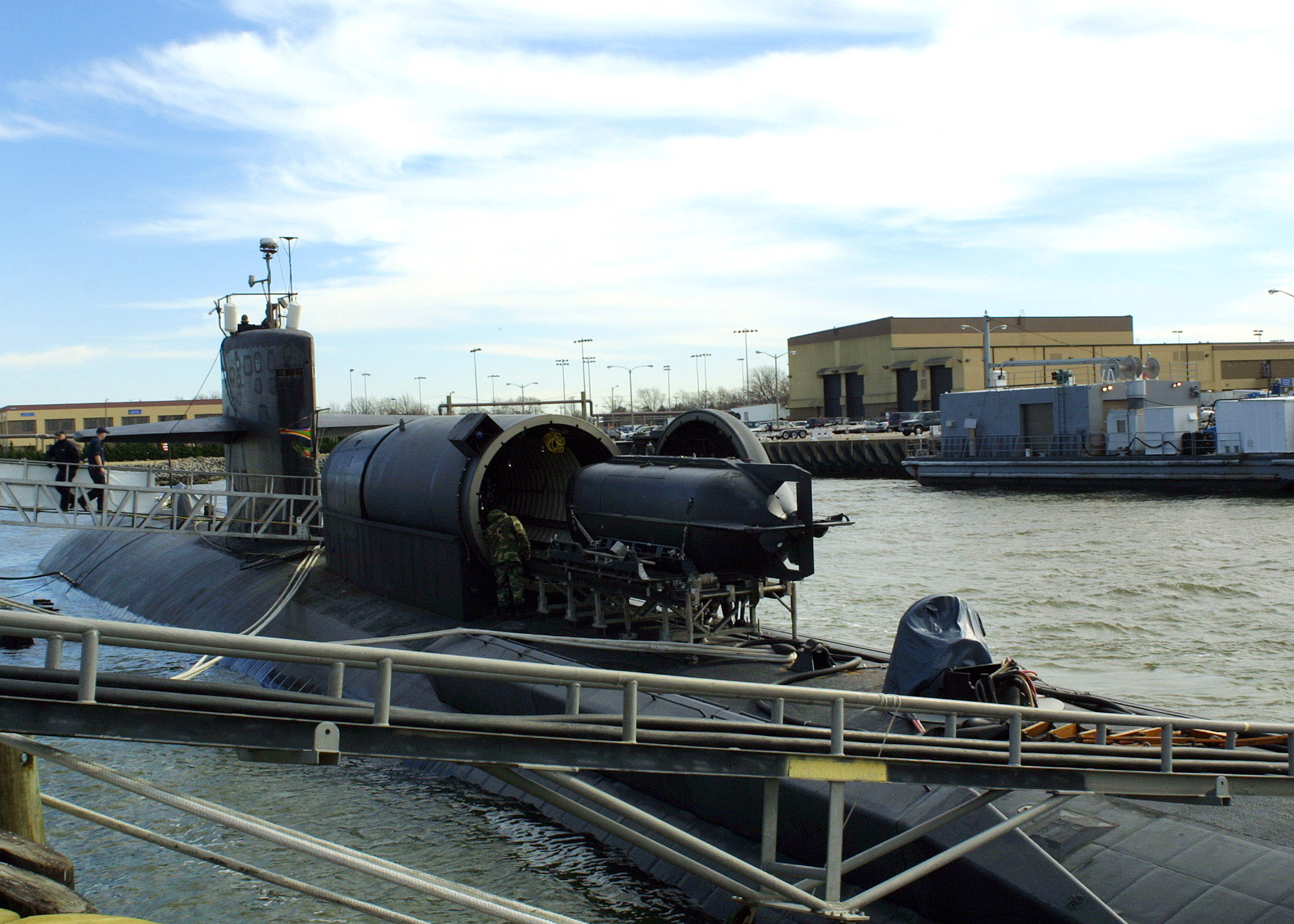

As for the suggestion that it could be intended as a mobile DF-21 [anti-ship ballistic-missile] platform, I initially reacted with skepticism. Surely the missile’s too big, right? Nope – the DF-21 turns out simply to be a land-based version of the submarine-launched JL-1 SLBM, so it's small enough to be taken to sea. But what would be the point? Well, extending the range of the “access denied” area for U.S. forces seems like a pretty good goal, if a little gratuitous. The point of anti-access weapons is to keep opponents away from your stuff – most importantly, to keep an aircraft carrier out of its aircraft’s effective combat radius from Taiwan. Keeping American carriers out of the western Philippine Sea is one thing; parking a sea-mobile DF-21 east of Taiwan and pushing the carriers further east seems to be a wasteful expenditure of resources. Another important aspect of anti-access weapons generally and the DF-21 specifically is that the Chinese are going to want us to know that it’s there. They’d much rather we just stay out because of the prospect of a carrier getting shot than that they actually have to shoot at a carrier and then we stay out, wouldn’t you think? SLBMs as an assured second-strike ICBM capability: great idea. SLBMs as a hidden anti-access weapon make less sense to me.
It’s not really plausible that this could be initially intended for JL-2 tests and then to carry a seaborne DF-21: the sizes of the missiles are too different. The JL-2 is 2m in diameter and 13m long, while the JL-1 is just 1.4m/10.7m. Based on the size – it’s significantly larger than the YUAN SSK also visible in this picture – it seems likely to me that it’s designed for the bigger missile and will be a SLBM test ship.

Unrelated note: There’s been some recent fuss about the Chinese aircraft carrier and whether it’s a big deal or not. I hope to address this debate in an upcoming post. Teaser: it’s not a big deal, but it’s not the Chinese naval capability that matters to us.
Gulliver again: Personally, I think it's my responsibility to assure you that all of the speculation above is nonsense. The hatch in question is really a bay door for the sophisticated caterpillar propulsion device, a fact that was revealed through consultations with a subject matter expert during hours of imagery analysis, shown here.

Tuesday, February 9, 2010
Turns out the SECDEF also thinks it's a bad idea for allies to sell advanced weapons systems to countries working at cross purposes to NATO
Remember how the French were gonna sell Mistral-class amphibs to Russia? (Perhaps surprisingly, the posts "Dirty French!" and "Dirty French pt 2" had nothing to do with this.) Yeah, I didn't think that was that cool of an idea when it came up three months ago, and now the deal has been inked. Turns out Secretary Gates agrees with me on the fundamental un-coolness of this.
Defense Secretary Robert M. Gates told French officials Monday that he was concerned about their plans to sell Mistral-class amphibious assault ships to Russia, although there is little if anything the United States could do to block the deal, officials said.Russia has been engaged in negotiations for months over what would be the first significant purchase of advanced NATO weaponry since the collapse of communism. Each Mistral warship costs up to $750 million, and the vessels, which can launch helicopters and armored vehicles, would be viewed as a notable addition to the Kremlin’s rusting fleet.Mr. Gates chose the well-known diplomatic code for disagreement in describing his discussion of the arms sale with his French counterpart, Defense Minister Hervé Morin.“I think I would just say that we had a good and thorough exchange of views,” Mr. Gates said.Geoff Morrell, the Pentagon press secretary, said later that Mr. Gates’s meetings here were “very amicable and positive” on issues that included the NATO effort in Afghanistan, but that Mr. Gates “made our concerns very clear” on the arms sale.
According to media reports, France has agreed to sell one Mistral to Russia and the sale of an additional three ships is under discussion. Information Dissemination, which can be a bit dense for this idiot non-engineer but ought to be your go-to blog for maritime stuff if you care about all that, expresses some confusion on this point. I've seen it reported elsewhere that only three Mistral-class ships exist: the one being sold to Russia, and two currently in the French fleet. That means that the three additional ships would have to be built to order, and some people are even speculating about a licensed production agreement with Russia.
Uh, what?
Don't get me wrong, I'm not saying that the U.S. should have veto power over anyone else's arms sales or other military contacts, but aren't we supposed to be on the same team here? Russia's certainly entitled to its own defense program, and I'll be the first to say that there are certain things we can do to give Moscow assurances about its own territorial integrity and security. But amphibious assault vehicles? Really? Where are these things gonna be based? And what missions are they gonna be used for? It seems clear to me that they'll go to the Black Sea fleet (if only because there aren't a whole ton of other warm-water ports), and that they'll be used to menace the Georgians (and perhaps the Ukrainians).
Dmitry Gorenburg of the Russian Military Reform blog does a good job of dissecting the rationale from a Russian perspective here in "Why the Mistral":
Whether this is the ship that should be built is another matter entirely. Various authors have made the case that the Mistral is not the ship that the Russian Navy needs. It may be that at least part of the reason for its purchase has to do with political factors, such as improving Russian-French relations. Or it may be that the Navy wants a versatile ship that can be used in many different ways.While because of its versatility I don’t think it would be wasted in the Russian Navy, it’s probably not the best use of the limited procurement budget. It might make a good utility ship, good for “conducting independent amphibious operations in distant locales” but is that really going to be a primary mission for the Russian Navy in coming years? It seems to me that for the foreseeable future, the Navy’s main missions will consist of protecting sea lanes and showing the flag. The Mistral could be used for these kinds of operations, but they are not its primary purpose. Given the money that would be spent on this ship, it seems that the RFN might as well get exactly what it needs.
So is this some kind of malign action by the the Russians, or are they just being stupid? (Or, as I always ask in the case of U.S. defense procurement, is there someone with a significant stake in the successful conclusion of this deal exerting inappropriate pressure on the decision-makers?)
And perhaps the more important question, and the one over which the U.S. and other NATO allies should have more influence: WTF are the French doing? I've yet to see any explanation from the French side of things, any justification of how this advances French foreign policy or security objectives. So: anybody want to speculate? Any of our French readership (or authorship!) want to speak up in defense of the strategic calculus behind this decision, or try to explain to us exactly what that is?
Subscribe to:
Posts (Atom)