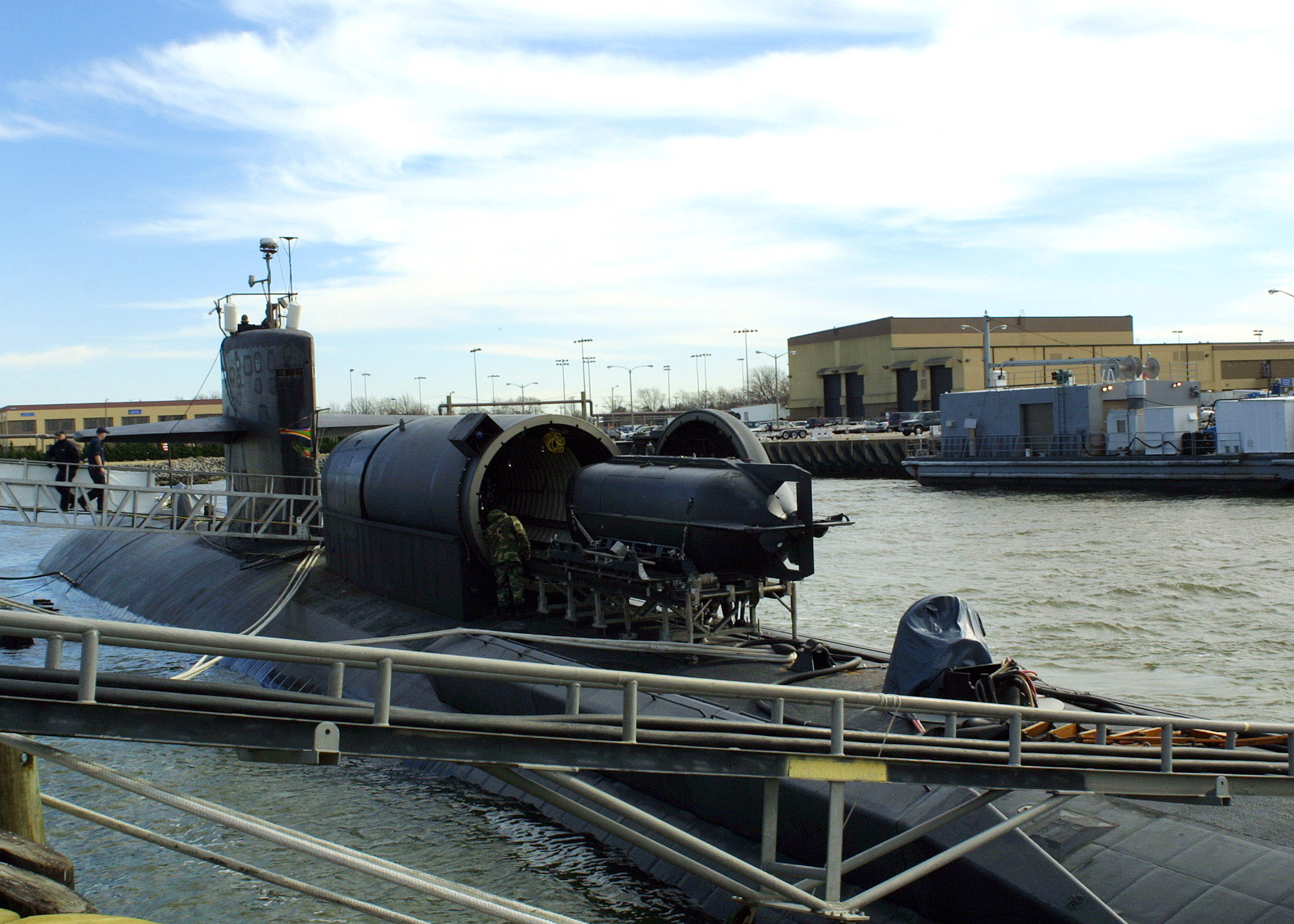
So I was all geared up to write about the Chinese aircraft carrier when I ran across this article in which the American Enterprise Institute’s Gary J. Schmitt and Richard Cleary argue that the United States needs to build diesel submarines. Submarines being a topic near and dear to my heart, I couldn’t help but dash off a few paragraphs about how they’re completely wrong.
First, their premise is faulty.
The U.S. Navy faces a fundamental dilemma: It needs more submarines, but the overall defense budget required to build those submarines is headed south.
The U.S. Navy doesn’t just need more submarines; it needs more of the type of submarines we’ve already got. Submarines perform a whole range of missions for the fleet and combatant commanders, including intelligence, surveillance, and reconnaissance (ISR), battlespace preparation, sea control, and land attack. The CNO tells me that they’re critical to our ability to project power ashore in the face of area denial and anti-access weapons. So if all submarines are good at all these things, then more of any submarines = more good things, right? Well, no. What Mr. Schmitt and Mr. Cleary don’t tell you is the dirty little secret about diesel submarines: they’re really just mines that can move a little.
A little explanation is in order here. The great advantage of a nuclear submarine is its inexhaustible (in the short term) power supply. A nuclear reactor can provide all the electrical and propulsion power you need, and then some, for as long as you want it (well, for at least double-digit years between refuelings). So a nuclear submarine can run around at max speed all the time. A LOS ANGELES-class SSN can get underway from San Diego and run at 25 knots to the Taiwan Strait with nary a thought for fuel consumption. It has atmosphere control equipment that disposes of carbon dioxide and carbon monoxide and makes oxygen from water; it can go weeks without exchanging its atmosphere. The submerged endurance of a nuclear submarine is limited only by how much food it can carry for the crew.
A diesel submarine, on the other hand, lacks the inexhaustible power supply provided by a nuclear reactor. It has two very different modes of operation: battery power and diesel engines. A diesel engine requires a continuous supply of air to operate; hence, the diesel SSK can only snorkel (operate its diesel engine) while surfaced or at periscope depth (submerged to just below the surface with a snorkel mast raised above the surface to supply air to the engine). When snorkeling, a modern diesel submarine typically uses the electrical power provided by the diesel generator to charge the battery and power electric motors for propulsion. While submerged below periscope depth, all electrical and propulsion power is provided by the ship’s battery. The battery can only be charged while snorkeling. Significant propulsion loads – i.e. going fast – discharges the battery terribly fast. A modern SSK may be able to spend a week at 2 knots on one battery charge but only hours at 20 knots. As a result, a prudently-operated diesel submarine will spend the vast majority of its time operating at very slow speeds – about the speed at which a man walks.
Yeah, yeah, I know: AIP. Air-independent propulsion does not make a diesel submarine into something else; it makes it better at being a diesel submarine. It allows the SSP to provide propulsion power from a source other than the battery while submerged, but the power capacity is so low that it is still limited to very slow speeds unless it disregards battery discharge rate.
American submarines spend much of their time forward-deployed, operating covertly. Instead of the two weeks required for an SSN to transit from the West Coast to the Western Pacific, a diesel submarine would take a month and a half. In a standard deployment cycle, in which a submarine spends six months out of every year and a half on deployment, less than three months would be available for operations. Diesel submarines do not lend themselves well to covert operations in opposition-held littoral areas; an SSK will typically run its diesel engine – rather a noisy evolution – daily during nighttime hours to recharge its batteries.
The authors claim that “diesel submarines are smaller, stealthier and more maneuverable in tight spaces than nuclear submarines.” I can’t argue with all of that. They are smaller. As for maneuverability in tight spaces… I’m not sure what that does for you. The ocean doesn’t have many tight spaces, and a nuclear submarine performs just as well in the shallow waters of a littoral environment as does a diesel boat. Regarding stealth, Mr. Scmitt and Mr. Cleary are once again laboring under a misapprehension. It is generally true that a diesel submarine operating on the battery is quieter than a nuclear submarine; the support systems required to be run continuously to keep a reactor operating generate some noise and a diesel submarine does not have similar equipment. However, effective incorporation of acoustic quieting technologies and sound silencing programs has minimized noise levels from American nuclear submarines. While the same cannot be said for many other countries’ SSNs, an SSK enjoys no stealth advantage over a LOS ANGELES- or VIRGINIA-class boat.
It is true that the U.S. Navy is struggling to improve its Anti-Submarine Warfare (ASW) capabilities. This problem isn’t confined to diesel submarines, though their low radiated noise levels do exacerbate the problem. Here’s the thing: finding a quiet submarine in a big ocean is hard. If that submarine can get up in your business and mix things up, it’s a hell of a lot harder. But an SSK really can’t do that. Because it will always suffer the speed limitations imposed by battery operations, a diesel submarine is little more than a mine with legs. It can park in a spot and wait for the good guys to drive by – and don’t get me wrong, that can be a hugely useful capability when you’re talking about choke points like the Straits or Hormuz, Malacca, or Luzon – but that’s about it. An SSK can’t charge from Hawaii to the South China Sea in days or chase an aircraft carrier in the open ocean. This is the fundamental problem with the suggestion that the U.S. should build diesel submarines. The diesel submarine is an outstanding weapon for its purpose. The diesel submarine is essentially an anti-access/area-denial technology. It’s a mine that can shoot an anti-ship cruise missile (ASCM) with a range of 100 nm instead of an encapsulated torpedo with a range of 1 nm. It’s a useful tool for the Chinese to keep our aircraft carriers out of the area east of Taiwan or to block the Luzon Strait, or for the Russians to choke the routes into their SSBN bastions and their territorial waters. It’s not useful for the things that the United States wants from its submarines.
On top of which, there’s logistical, manning, training, and industrial base concerns touched on nicely here, but after a rambling 1200 words I figure you deserve a break.
G: Little does he know I make you guys read about acquisition all the time...
G: Little does he know I make you guys read about acquisition all the time...